NASA Orion return, Victor Glover Moon mission, Artemis 2 crew news, San Diego splashdown,
By [Shrikant/Sone Publication] | April 11, 2026
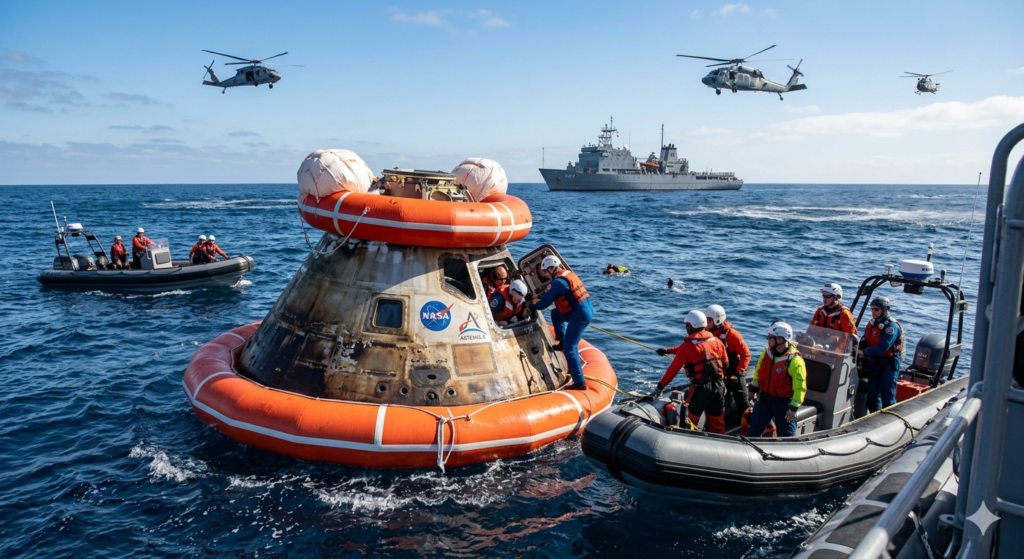
The eyes of the world were fixed on the Pacific Ocean yesterday as a streak of fire across the California sky signalled a historic homecoming. At 5:07 p.m. PDT, the NASA Orion spacecraft, carrying the four-member Artemis II crew, successfully splashed down off the coast of San Diego, marking the end of the first crewed lunar mission in over five decades.
At Sone Publication, we are diving deep into why this mission isn’t just a “win” for NASA, but a giant leap for global space exploration.
The Perfect Landing: 10 Days in Deep Space
After a 10-day journey that took them 252,756 miles away from Earth—the farthest any human has ever travelled—astronauts Reid Wiseman, Victor Glover, Christina Koch, and Jeremy Hansen are back on home soil.
The re-entry was the mission’s most “white-knuckle” moment. The Orion capsule hit the Earth’s atmosphere at speeds of 25,000 mph, with the heat shield enduring temperatures of nearly 5,000 degrees Fahrenheit. Thanks to a new “lofted” re-entry technique, the spacecraft stayed stable, bobbing into the ocean exactly on target.
Why Artemis II is Trending Worldwide
This mission broke more than just distance records. It shattered “glass ceilings” in the stars:
- Victor Glover became the first person of colour to leave Earth’s orbit.
- Christina Koch became the first woman to venture into deep space.
- Jeremy Hansen represented the first non-American (Canada) to fly to the Moon.
Beyond the demographics, the crew captured stunning high-definition footage of the Moon’s far side and even witnessed a total solar eclipse from a vantage point no human has ever had before.
The Recovery: USS John P. Murtha
The recovery operation was a masterclass in military and scientific precision. The USS John P. Murtha, a Navy transport dock ship, was waiting at the splashdown coordinates. Within two hours, the crew was extracted using the “front porch” inflatable system and flown by helicopter to the ship’s deck for medical evaluations.
Initial reports from NASA medical teams confirm that all four astronauts are in excellent health, despite the physical toll of deep-space radiation and microgravity.
What’s Next? The Road to Artemis III
The success of Artemis II is the final “green light” for Artemis III, which aims to land the first humans on the Lunar South Pole in late 2027. The data gathered from Orion’s heat shield and the crew’s biological samples will be used to refine the life-support systems for that historic landing.
As the crew returns to the Johnson Space Center in Houston today to reunite with their families, the world celebrates a mission that proved one thing: the Moon is no longer a memory—it is our future.